17 July 2026
How to Write a CV Based on a Job Description (Template, Examples & Free AI Method)
How to Write a CV Based on a Job Description (Template, Examples & Free AI Method)
Recruiters spend an average of six to eight seconds on a first pass of a CV. In that window, they aren't reading your life story — they're scanning for proof that you match the job description in front of them. That's why the single highest-leverage skill in job hunting isn't writing a CV. It's writing a CV based on the job description, every single time you apply.
This guide walks you through exactly how to do that: a repeatable process, a ready-to-use template, real before-and-after examples, a version for freshers with no experience, and a free method (including ChatGPT) to tailor your resume in minutes.
Why You Should Tailor Your Resume to Every Job Description
Most companies now use an Applicant Tracking System (ATS) to filter CVs before a human ever sees them. These systems scan for keywords, skills, and phrases lifted directly from the job description. A generic, one-size-fits-all CV — even a strong one — often gets filtered out simply because it doesn't echo the language of the posting.
Tailoring isn't about lying or inventing experience. It's about:
- Mirroring the exact skills and terminology the employer used
- Reordering your achievements so the most relevant ones appear first
- Cutting content that doesn't support this specific application
- Proving, in the first third of the page, that you can do this job
How to Write a CV Based on a Job Description: Step-by-Step
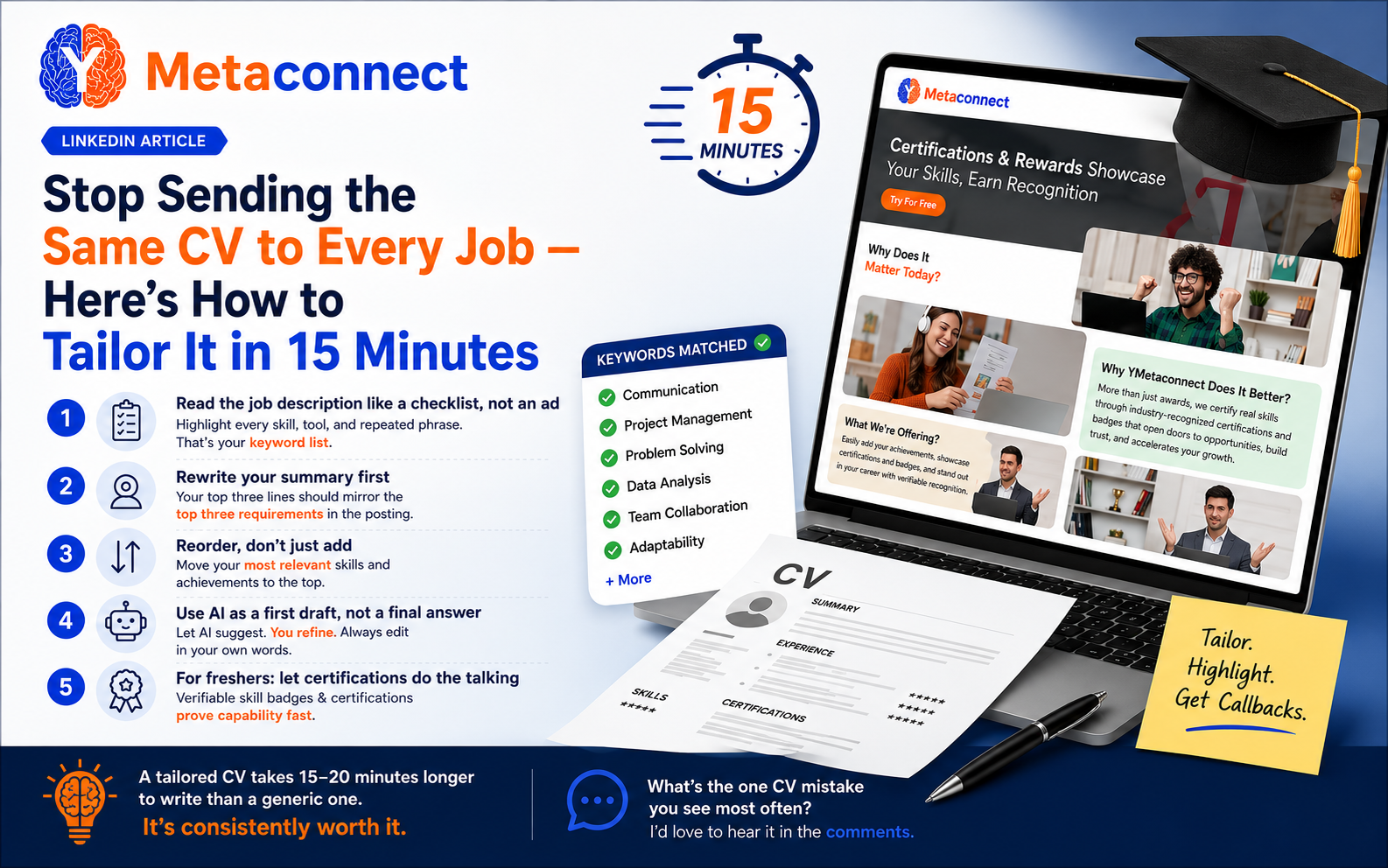
- Read the job description twice. First for overall context, second with a highlighter for hard skills, soft skills, tools, certifications, and repeated phrases.
- Build a keyword list. Note every required skill (e.g., 'stakeholder management', 'SQL', 'Agile', 'B2B sales') exactly as written in the posting.
- Match your experience to each keyword. For every keyword, find one bullet point in your work history that proves it — using numbers wherever possible.
- Rewrite your professional summary. Your top 3–4 lines should directly reflect the top 3–4 requirements in the job description.
- Reorder your skills section. Put the skills mentioned in the JD at the top of your skills list, not buried at the bottom.
- Adjust your bullet points' language. If the JD says 'cross-functional collaboration' and your CV says 'teamwork', change it to match.
- Check your job title alignment. If your actual title differs from the industry-standard term used in the JD, add the standard term in brackets.
- Proofread for keyword stuffing. The CV must still read naturally to a human, not just a bot.
CV Based on Job Description: Free Template
Use this structure as your baseline, then customize each bracketed section using the keyword list you built above.
- Full Name | Phone | Email | LinkedIn | Location
- Professional Summary — 2–3 lines mirroring the top requirements of the JD, including your years of experience and key skill match
- Core Skills — 6–10 keywords pulled directly from the job description, most relevant first
- Professional Experience — reverse chronological, each role with 3–5 achievement-based bullets using JD language and measurable results
- Education — degree, institution, year
- Certifications / Projects — anything that directly supports this specific role
Keep it to one page for under 8 years of experience, two pages maximum beyond that.
CV Based on Job Description: Example
Job description snippet: "Looking for a Marketing Executive with experience in social media strategy, campaign analytics, and content calendars."
Before (generic bullet): Managed social media accounts and created content.
After (tailored to the JD): Built and executed a social media strategy across 4 platforms, using campaign analytics to optimize a content calendar that grew engagement by 38% in 6 months.
Notice the tailored version reuses the exact phrases from the job description — "social media strategy", "campaign analytics", "content calendar" — while adding a measurable outcome.
How to Write a CV Based on a Job Description for Freshers
With little or no work experience, freshers can still tailor a CV effectively by leaning on academic projects, internships, coursework, and certifications instead of job history.
- Lead with a summary that states your degree, key skill areas, and career goal — matched to the JD's requirements
- Turn coursework and final-year projects into achievement bullets (tools used, outcome, scale)
- List certifications and skill badges relevant to the role — these substitute for years of experience and show employers you're proactive
- Include internships, part-time work, or volunteering, framed around transferable skills mentioned in the JD
Building a portfolio of verifiable, skill-based certifications is one of the fastest ways for freshers to close the experience gap on a CV. Platforms like YMetaconnect's certificates and skill badges let learners earn recognized proof of ability that can be added straight into the certifications section of a tailored CV.
How to Tailor Your Resume to a Job Description for Free
You don't need paid software to do this well. A completely free workflow:
- Paste the job description into a document and highlight repeated skills/keywords manually
- Open your master CV (the long, unedited version with everything you've ever done)
- Copy only the sections relevant to this job into a new file
- Rewrite the top third (summary + top skills) to mirror the JD
- Run it through a free grammar checker before submitting
This manual method takes 15–20 minutes per application and is the most reliable free way to tailor a resume without any tools.
How to Tailor Your Resume to a Job Description Using ChatGPT (Free AI Method)
If you want to speed up the process, ChatGPT (or any free AI chat tool) can help — as long as you guide it well and edit the output yourself. A simple, free prompt workflow:
- Paste the full job description into the chat
- Paste your current CV or a list of your work experience underneath it
- Ask: "Compare my CV to this job description. List the keywords and skills I'm missing, and suggest which of my existing bullet points I should rewrite to match the JD's language."
- Ask the tool to rewrite your professional summary using the top requirements from the JD
- Review every AI suggestion — remove anything inaccurate or exaggerated, and keep the final wording in your own voice
AI is excellent at spotting keyword gaps quickly and free-of-charge, but a human must always verify that every claim on the final CV is true and defensible in an interview.
Job Description for CV Examples: What to Look For
Not every line in a job posting deserves equal weight. When scanning a job description for your CV, prioritize:
- The job title itself, and any variations used throughout the posting
- Requirements listed as "must-have" vs. "nice-to-have"
- Repeated words or phrases — repetition signals what the employer values most
- Named tools, software, methodologies, or certifications (e.g., Excel, Salesforce, Scrum, PMP)
- Soft skills framed as outcomes (e.g., "ability to manage multiple stakeholders under tight deadlines")
Tailored Resume Examples: Quick Reference
Generic: "Responsible for handling customer queries."
Tailored to a JD requiring "customer retention" and "CRM tools": "Resolved 50+ customer queries weekly via [CRM tool], improving customer retention rate by 22% quarter-over-quarter."
Generic: "Worked on team projects."
Tailored to a JD requiring "cross-functional collaboration": "Led cross-functional collaboration between design, engineering, and marketing to ship 3 product features on schedule."
Final Takeaway
A CV tailored to the job description will consistently outperform a generic one — in ATS scans and with human reviewers. The process is simple but requires discipline: read the JD carefully, mirror its language, prove your fit with numbers, and repeat for every application.
If you're still building the skills and certifications that will fill out that tailored CV, explore YMetaconnect's Career Accelerator and skill badges & certificates to earn verifiable proof of your abilities that you can add directly to your resume and LinkedIn profile.



 Jumpstart Journal
 R-A-R Activity
 Critical Thinking Exercise
 Picture Reflection Or Photo Caption
 Presentation
 Thematic Apperception Test (TAT)
 Flash Card
 Micro Learning
 Research Skills
 Workshop Report Presentation
 MCQ And Descriptive Questions
 Video Analysis Presentation
 Scenario Planning
 Problem Solving
 Trivia Quiz
 Flipped Classroom
 Generative Knowledge Interviewing
 Think-Pair-Share
 Fish Bowl Group Activity
 Jigsaw Method
 Simulation
 Peer Interview
 Role Play
 Debate
 Group Discussion
 Futurism And Trend Analysis
 Report Presentation
 Assignment Presentation
 Research Article Review Presentation
 Peer Teaching
 Industrial Visit Report Presentation
 Video Podcast
 Games
Games
 Business Games
 Collaborative Project
 Team Building
 Role Reversal
 Leadership Activity
 Pitch Deck
 Case Analysis Presentation


 Learner
 Mentor
 Organisation
 Learner
 Mentor
 Organisation