Our Insights

Explore powerful ideas, tools, and methods that make education more engaging, meaningful, and effective.

How to Write a CV Based on a Job Description (Template, Examples & Free AI Method)

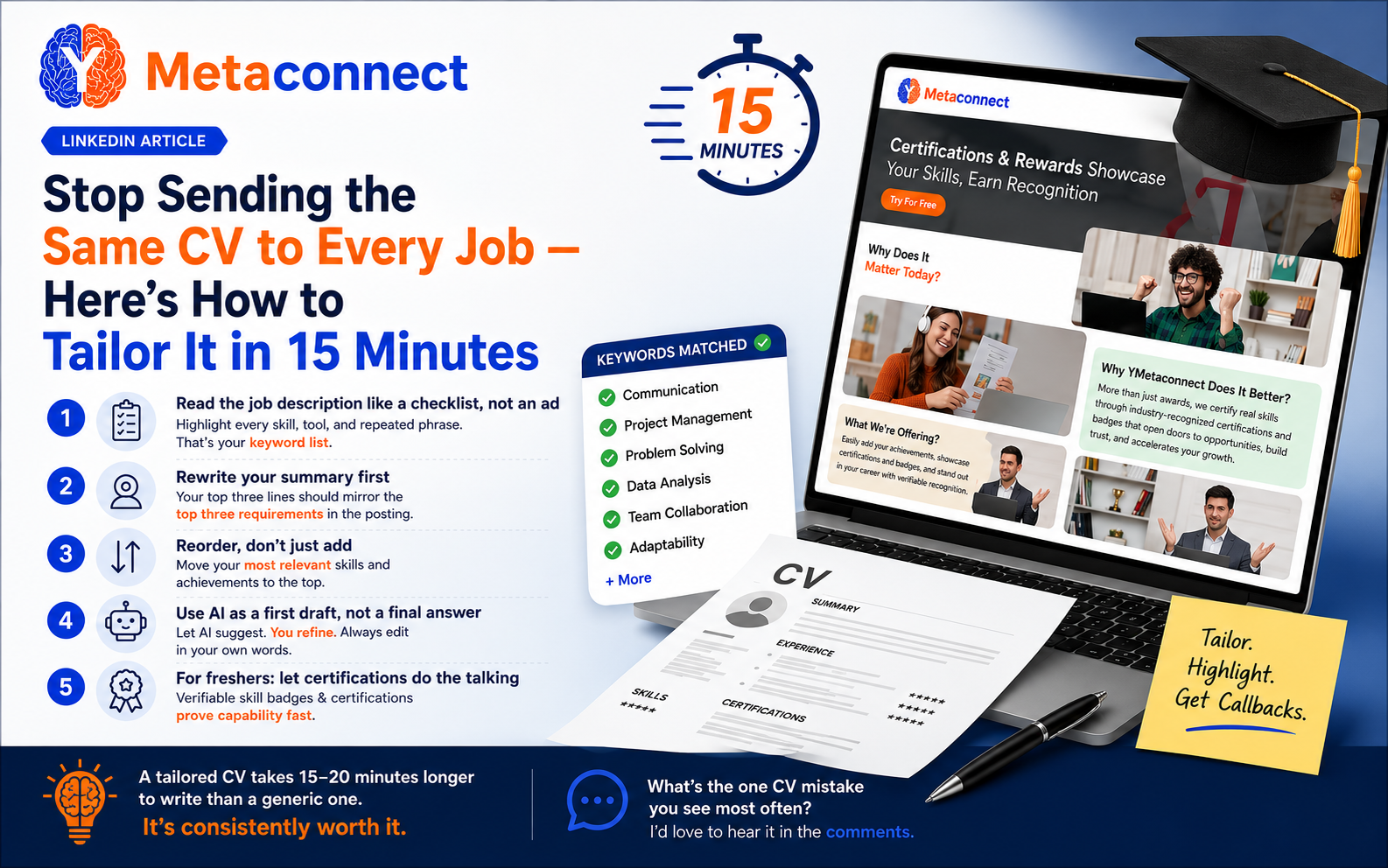
How to Write a CV Based on a Job Description (Template, Examples & Free AI Method) Recruiters spend an average of six to eight seconds on a first pass of a CV. In that window, they aren't reading your life story — they're scanning for proof that you match the job description in front of them. That's why the single highest-leverage skill in job hunting isn't writing a CV. It's writing a CV based on the job description, every single time you apply. This guide walks you through exactly how to do that: a repeatable process, a ready-to-use template, real before-and-after examples, a version for freshers with no experience, and a free method (including ChatGPT) to tailor your resume in minutes. Why You Should Tailor Your Resume to Every Job Description Most companies now use an Applicant Tracking System (ATS) to filter CVs before a human ever sees them. These systems scan for keywords, skills, and phrases lifted directly from the job description. A generic, one-size-fits-all CV — even a strong one — often gets filtered out simply because it doesn't echo the language of the posting. Tailoring isn't about lying or inventing experience. It's about: Mirroring the exact skills and terminology the employer used Reordering your achievements so the most relevant ones appear first Cutting content that doesn't support this specific application Proving, in the first third of the page, that you can do this job How to Write a CV Based on a Job Description: Step-by-Step Read the job description twice. First for overall context, second with a highlighter for hard skills, soft skills, tools, certifications, and repeated phrases. Build a keyword list. Note every required skill (e.g., 'stakeholder management', 'SQL', 'Agile', 'B2B sales') exactly as written in the posting. Match your experience to each keyword. For every keyword, find one bullet point in your work history that proves it — using numbers wherever possible. Rewrite your professional summary. Your top 3–4 lines should directly reflect the top 3–4 requirements in the job description. Reorder your skills section. Put the skills mentioned in the JD at the top of your skills list, not buried at the bottom. Adjust your bullet points' language. If the JD says 'cross-functional collaboration' and your CV says 'teamwork', change it to match. Check your job title alignment. If your actual title differs from the industry-standard term used in the JD, add the standard term in brackets. Proofread for keyword stuffing. The CV must still read naturally to a human, not just a bot. CV Based on Job Description: Free Template Use this structure as your baseline, then customize each bracketed section using the keyword list you built above. Full Name | Phone | Email | LinkedIn | Location Professional Summary — 2–3 lines mirroring the top requirements of the JD, including your years of experience and key skill match Core Skills — 6–10 keywords pulled directly from the job description, most relevant first Professional Experience — reverse chronological, each role with 3–5 achievement-based bullets using JD language and measurable results Education — degree, institution, year Certifications / Projects — anything that directly supports this specific role Keep it to one page for under 8 years of experience, two pages maximum beyond that. CV Based on Job Description: Example Job description snippet: "Looking for a Marketing Executive with experience in social media strategy, campaign analytics, and content calendars." Before (generic bullet): Managed social media accounts and created content. After (tailored to the JD): Built and executed a social media strategy across 4 platforms, using campaign analytics to optimize a content calendar that grew engagement by 38% in 6 months. Notice the tailored version reuses the exact phrases from the job description — "social media strategy", "campaign analytics", "content calendar" — while adding a measurable outcome. How to Write a CV Based on a Job Description for Freshers With little or no work experience, freshers can still tailor a CV effectively by leaning on academic projects, internships, coursework, and certifications instead of job history. Lead with a summary that states your degree, key skill areas, and career goal — matched to the JD's requirements Turn coursework and final-year projects into achievement bullets (tools used, outcome, scale) List certifications and skill badges relevant to the role — these substitute for years of experience and show employers you're proactive Include internships, part-time work, or volunteering, framed around transferable skills mentioned in the JD Building a portfolio of verifiable, skill-based certifications is one of the fastest ways for freshers to close the experience gap on a CV. Platforms like YMetaconnect's certificates and skill badges let learners earn recognized proof of ability that can be added straight into the certifications section of a tailored CV. How to Tailor Your Resume to a Job Description for Free You don't need paid software to do this well. A completely free workflow: Paste the job description into a document and highlight repeated skills/keywords manually Open your master CV (the long, unedited version with everything you've ever done) Copy only the sections relevant to this job into a new file Rewrite the top third (summary + top skills) to mirror the JD Run it through a free grammar checker before submitting This manual method takes 15–20 minutes per application and is the most reliable free way to tailor a resume without any tools. How to Tailor Your Resume to a Job Description Using ChatGPT (Free AI Method) If you want to speed up the process, ChatGPT (or any free AI chat tool) can help — as long as you guide it well and edit the output yourself. A simple, free prompt workflow: Paste the full job description into the chat Paste your current CV or a list of your work experience underneath it Ask: "Compare my CV to this job description. List the keywords and skills I'm missing, and suggest which of my existing bullet points I should rewrite to match the JD's language." Ask the tool to rewrite your professional summary using the top requirements from the JD Review every AI suggestion — remove anything inaccurate or exaggerated, and keep the final wording in your own voice AI is excellent at spotting keyword gaps quickly and free-of-charge, but a human must always verify that every claim on the final CV is true and defensible in an interview. Job Description for CV Examples: What to Look For Not every line in a job posting deserves equal weight. When scanning a job description for your CV, prioritize: The job title itself, and any variations used throughout the posting Requirements listed as "must-have" vs. "nice-to-have" Repeated words or phrases — repetition signals what the employer values most Named tools, software, methodologies, or certifications (e.g., Excel, Salesforce, Scrum, PMP) Soft skills framed as outcomes (e.g., "ability to manage multiple stakeholders under tight deadlines") Tailored Resume Examples: Quick Reference Generic: "Responsible for handling customer queries." Tailored to a JD requiring "customer retention" and "CRM tools": "Resolved 50+ customer queries weekly via [CRM tool], improving customer retention rate by 22% quarter-over-quarter." Generic: "Worked on team projects." Tailored to a JD requiring "cross-functional collaboration": "Led cross-functional collaboration between design, engineering, and marketing to ship 3 product features on schedule." Final Takeaway A CV tailored to the job description will consistently outperform a generic one — in ATS scans and with human reviewers. The process is simple but requires discipline: read the JD carefully, mirror its language, prove your fit with numbers, and repeat for every application. If you're still building the skills and certifications that will fill out that tailored CV, explore YMetaconnect's Career Accelerator and skill badges & certificates to earn verifiable proof of your abilities that you can add directly to your resume and LinkedIn profile.

Why Every Mentor Should Build a Personal Learning Brand in 2026

Why Every Mentor Should Build a Personal Learning Brand in 2026 Mentorship has changed. Teaching a subject or delivering a lecture is no longer enough. Today's learners want guidance, real-world experience, personalized feedback, and continuous engagement — they're not just looking for information, they're looking for someone who can help them grow. This shift is a massive opportunity for professionals, educators, trainers, and industry experts. Instead of confining their knowledge to classrooms or corporate training rooms, mentors can now build a lasting digital presence that reaches learners across the globe. Knowledge Is Valuable Only When It's Shared Most professionals spend years building expertise through projects, research, leadership, and hard-won problem-solving. But too often, that knowledge never reaches the people who need it most. Turning practical experience into structured learning content lets mentors create resources that keep generating value long after they're published. A course recorded once can teach thousands of learners, indefinitely. This holds true across every field — technology, marketing, finance, healthcare, engineering, design, or leadership. Wherever there's real experience, there's an audience ready to learn from it. Modern Learners Want More Than Video Courses The online learning industry has moved past the "record and upload" model. Learners today expect: Interactive learning experiences Practical, real-world assignments Continuous assessment Personalized feedback Community discussions Career-focused guidance Static video lessons alone don't cut it anymore. Real learning happens when mentors actively engage with their audience and help them apply concepts to actual situations — not just watch and move on. Your Expertise Can Become Your Professional Identity Creating educational content isn't just about teaching anymore — it's about building a career asset. It helps mentors: Establish authority in their industry Build credibility with employers and organizations Expand their professional network Unlock new career opportunities Reach an international audience Generate additional income streams Every article published, every course created, and every learner helped adds another layer to a mentor's professional reputation. AI Makes Human Mentorship More Important, Not Less AI can answer a question in seconds. What it can't replace is: Experience Context Critical thinking Career guidance Personal encouragement Industry insight Learners still need mentors who can explain why something works, share the mistakes they've made along the way, and guide decisions based on real, lived experience. AI is becoming an assistant to great educators — not a substitute for them. Creating Courses Has Never Been Easier Modern education platforms let professionals publish courses without needing deep technical knowledge. There's no need to worry about hosting, infrastructure, or complex development — mentors can focus entirely on what matters: creating meaningful learning experiences. Platforms like YMetaConnect give educators the tools to build interactive courses, track learner progress, and reach a wider audience through AI-supported learning — so mentors spend more time teaching and less time managing technology. The Future Belongs to Educators Who Keep Learning The most successful mentors are lifelong learners themselves. They continuously update their knowledge, adapt to industry shifts, and embrace new teaching methods — a mindset that improves learner outcomes and keeps mentors professionally relevant in a fast-changing world. Education is no longer confined to classrooms. It's global, digital, collaborative, and constantly evolving. For professionals sitting on valuable knowledge, there has never been a better time to start building a personal learning brand. Because the next generation of learners isn't just searching for courses — they're searching for mentors who can inspire them to achieve more. Ready to turn your expertise into a course that keeps teaching long after you've moved on? Start building on YMetaConnect today.

How to Improve Slow Learners?

Many students do not learn slowly because they are weak, but because they need more time and support. Slow learners understand better when teaching is simple, clear, and repeated. They also do better with pictures, videos, and step-by-step explanations. A kind and patient classroom helps them feel safe and confident. When teachers give extra help and let them learn at their own speed, they improve slowly but surely. With the right support and encouragement, slow learners can do well in studies and grow with confidence in their own way. This blog covers the methods that show how to improve slow learners. 1. Repetition Method Repeating lessons and key concepts is very helpful for slow learners. It gives them more chances to understand the topic clearly and remember it better. When ideas are revised again and again, students feel more confident and less confused. Consistent revision is considered one of the most effective learning methods for students who require additional support. 2. Digital Resources Digital resources such as videos, games, and online learning tools make studying more interesting. They help slow learners understand difficult topics simply and visually. Learning becomes less stressful because students can see and interact with the content. Using technology can complement traditional slow learners materials and make learning more interactive. 3. Inclusive Classroom An inclusive classroom is one where every student is accepted and supported equally. Slow learners feel safe and comfortable in such an environment. A welcoming atmosphere encourages students to take part in interactive learning activities without hesitation. This helps them build confidence and improve their learning skills gradually. 4. Positive Atmosphere A positive classroom environment plays an important role in learning. Teachers show patience, give support, and treat all students fairly. Slow learners feel motivated when they receive encouragement and kind feedback. Understanding how to motivate slow learners begins with creating a classroom built on patience and support. 5. Group Activities Group activities allow slow learners to learn with their classmates. They get a chance to share ideas, ask questions, and learn in a friendly way. This improves their communication and teamwork skills. These tasks can be designed as self-paced learning activities to accommodate different learning speeds. 6. Extra Time Slow learners often need more time to understand lessons and complete tasks. Providing extra time removes pressure and helps them learn comfortably. They can think slowly and clearly without stress. This improves both understanding and academic results over time. This strategy is often included when educators explore how to improve weak students in the classroom. 7. Guidance Guidance from teachers and parents is very important for slow learners. It helps them understand lessons better and complete their schoolwork properly. Regular support makes them feel less confused and more confident. With continuous help, their learning improves gradually. 8. IEP An Individual Education Plan (IEP) is designed according to each student’s needs. It focuses on their learning speed, strengths, and difficulties. Lessons are made simpler and more suitable for them. An IEP often contributes to building a personalized learning environment that supports long-term progress. 9. Audio-Visual Aids Audio-visual aids include videos, images, and animations used in teaching. These tools make learning easier and more interesting for slow learners. They help students understand concepts quickly by seeing and hearing information together. This also improves memory and long-term understanding. 10. Peer Tutoring Peer tutoring means classmates help slow learners understand lessons. Friends explain topics in simple language, which is easier to follow. It also creates a friendly and comfortable learning environment. This improves confidence and strengthens understanding. 11. Realistic Goals Setting small and realistic goals helps slow learners feel successful. They are not overwhelmed by difficult tasks and can complete work step by step. Achieving small goals keeps them motivated. This builds confidence and encourages continuous learning. 12. Understand Needs Teachers must understand the individual needs of each student. Slow learners have different strengths and challenges compared to others. Recognizing individual needs is essential when addressing the problems of slow learners in education. 13. Customize Lessons Customized lessons are designed based on the learner’s ability and pace. This helps slow learners simply understand topics. Teachers adjust content so students can learn comfortably. It increases interest and improves learning outcomes. 14. Differentiated Instruction Differentiated instruction means teaching students in different ways based on their needs. Slow learners receive simpler explanations and step-by-step guidance. This makes learning easier and less confusing. It helps them study at their own speed. 15. Smaller Steps Breaking big tasks into smaller steps makes learning easier. Slow learners can complete one part at a time without stress. This helps them stay focused and confident. It also improves understanding and task completion. 16. Discussion Classroom discussions enable students to engage in open discussions and ask questions freely. Slow learners get a chance to clear their doubts easily. This helps them understand lessons better. It also improves their participation and confidence. 17. Supportive Environment A supportive environment helps slow learners feel safe and accepted. Teachers are patient and guide them without putting pressure on them. This encourages them to try without fear of mistakes. It improves their learning experience and confidence. 18. Chunking & Scaffolding Chunking means breaking information into small, easy parts. Scaffolding provides step-by-step support using charts and tools. Both methods make learning simpler for slow learners. They help improve understanding and memory retention. They are commonly included in an action plan for slow learners to enhance understanding and independence. Conclusion Slow learners need patience, understanding, and the right teaching strategies to succeed. Every child learns at a different pace, and providing extra support can make a significant difference in their academic growth. Techniques such as repetition, peer tutoring, differentiated instruction, audio-visual aids, and customized lessons help make learning easier and more effective. Creating a positive and supportive classroom environment is equally important. When teachers recognize individual needs, set realistic goals, and encourage participation, slow learners become more confident and motivated. Small improvements over time can lead to meaningful progress. With proper guidance from teachers, parents, and peers, slow learners can overcome challenges and develop their skills successfully. By focusing on their strengths and providing consistent support, educators can help them achieve their full potential and enjoy a rewarding learning experience.

STAR Method Interview Guide for Freshers

Job interviews can feel stressful for freshers, especially when interviewers ask questions about past experiences, challenges, or achievements. Many candidates know what they want to say but struggle to organize their answers clearly. This is where the STAR method can help. STAR stands for Situation, Task, Action, and Result. It is a simple interview technique that helps you professionally answer behavioral questions. Whether your examples come from college projects, internships, volunteer work, or extracurricular activities, the STAR method can help you present your skills with confidence. Many recruiters also recommend using the star format interview approach to answer behavioral questions. In this guide, you will learn how the STAR method works, why it is important for freshers, and how to use it effectively in interviews. What Is the STAR Method? The STAR method is a simple framework used to answer behavioral interview questions. It helps candidates explain their experiences in a clear and organized manner, making it easier for interviewers to understand their skills and achievements. ➢ Understanding the STAR Framework STAR is an acronym that stands for: Situation – Describe the background or context. Task – Explain your responsibility or challenge. Action – Share the steps you took. Result – Explain the outcome of your actions. This structure helps you tell a complete story instead of giving short or confusing answers. The star technique is widely used by job seekers to organize responses and showcase their abilities effectively. ➢ Breaking Down Each STAR Step The first step is the Situation, where you briefly explain what happened. Next comes the Task, which describes what needs to be done. The Action section focuses on the steps you personally took to solve the problem or complete the task. Finally, the Result highlights what was achieved and what you learned from the experience. ➢ Why Employers Prefer STAR Answers? Recruiters often ask behavioral questions because they want to understand how candidates handle real-life situations. STAR answers provide clear examples instead of general statements. These responses enable employers to assess essential skills, including teamwork, communication, leadership, problem-solving, and adaptability. The STAR method is especially useful when answering competency based questions examples commonly asked during hiring processes. Why Should Freshers Use the STAR Method? Many freshers believe they need years of work experience to answer interview questions effectively. However, employers understand that entry-level candidates are still building their professional experience. The STAR method helps freshers use examples from college, internships, volunteer work, and personal projects to demonstrate valuable skills. ➢ Building Confidence During Interviews One of the biggest benefits of the STAR method is that it gives you a clear structure to follow. Instead of thinking about what to say next, you can focus on telling your story step by step. This reduces nervousness and helps you communicate more confidently during interviews. Many freshers also use AI-powered interview practice tools to rehearse STAR-based responses before meeting recruiters. ➢ Showcasing Skills Without Experience Even if you have never worked full-time, you still have experiences that can demonstrate important skills. Academic projects, group assignments, competitions, volunteer activities, and practical project work can all provide strong examples for STAR answers can all be used in STAR answers. These examples help employers see your potential and willingness to learn. ➢ Giving Clear And Structured Answers Interviewers appreciate answers that are easy to follow. The STAR method prevents rambling and keeps your response focused on the most relevant details. As a result, your answers sound more professional and leave a stronger impression. How to Create Strong STAR Answers? Creating effective STAR answers requires preparation and practice. The more examples you prepare, the more comfortable you will feel during interviews. Focus on experiences that highlight the skills employers are seeking in recent graduates. Preparing STAR responses in advance can also help you answer tricky interview questions with greater confidence and clarity. ➢ Choosing The Right Example Select examples that relate to the job you are applying for. Think about situations where you demonstrated teamwork, leadership, problem-solving, communication, or time management skills. The best examples are specific and show how you handled a challenge successfully. ➢ Explaining Your Actions Clearly The Action section is the most important part of your answer. Interviewers want to know what you personally did, not just what the team achieved. Use clear language to explain your contribution and the steps you took to solve the problem or complete the task. ➢ Highlighting Results And Outcomes Always end your answer by explaining the result. Discuss what was achieved, what improved, or what you learned from the experience. Whenever possible, include measurable results such as improved grades, completed projects, or successful event outcomes. STAR Method Examples For Freshers The easiest way to understand the STAR method is through examples. These examples show how freshers can answer common behavioral interview questions. Remember that your answers should be based on your own experiences. ➢ Answering Teamwork-Based Questions Question: Tell me about a time you worked in a team. Situation: During my final year, I worked on a group project with four classmates. Task: We had to complete a research project and present it within one month. Action: I coordinated tasks, scheduled meetings, and ensured everyone completed their assigned work on time. Result: We submitted the project before the deadline and received excellent feedback from our professor. ➢ Responding To Leadership Questions Question: Tell me about a time you showed leadership. Situation: I was responsible for organizing a college cultural event. Task: I had to manage volunteers and ensure everything ran smoothly. Action: I assigned responsibilities, monitored progress, and resolved issues during the planning stage. Result: The event was successful, attracted high participation, and received positive reviews from students and faculty. ➢ Handling Problem-Solving Questions Question: Describe a challenge you faced and how you solved it. Situation: During an internship, our team experienced delays while collecting project data. Task: We needed to complete the project before the submission deadline. Action: I suggested a new data collection approach and helped organize tasks more efficiently. Result: The project was completed on time, and the supervisor appreciated our efforts. Common STAR Method Mistakes To Avoid While the STAR method is simple, many candidates make mistakes that weaken their answers. Knowing these mistakes can help you prepare better and improve your interview performance. A well-structured answer should be clear, concise, and focused on your contribution. ➢ Adding Too Much Background Information Some candidates spend too much time explaining the situation. This can make the answer lengthy and less engaging. Keep the background brief and focus more on your actions and results. ➢ Forgetting To Share The Results Many candidates explain what they did, but fail to discuss the outcome. Without a result, the interviewer cannot fully understand the impact of your actions. Always explain what happened and what was achieved. ➢ Giving Generic Or Unclear Examples Avoid vague statements such as "I worked hard" or "I helped the team." Instead, provide specific details about what you actually did. Specific examples make your answer more believable and memorable. Along with preparing STAR responses, candidates should also prepare questions to ask interviewer after interview to demonstrate interest and professionalism. Conclusion The STAR method is one of the most effective interview techniques for freshers. It provides a simple structure for answering behavioral questions and helps candidates present their experiences clearly and professionally. Even without full-time work experience, freshers can use examples from academic projects, internships, volunteer activities, and extracurricular events to demonstrate valuable skills. By focusing on the Situation, Task, Action, and Result, you can create strong answers that showcase your abilities and leave a positive impression on employers. With regular practice and preparation, the STAR method can help you feel more confident, improve your interview performance, and increase your chances of landing your first job.

What Recruiters Look for in a Portfolio in 2026?

The job market is changing faster than ever. In 2026, employers will care more about skills and abilities than just degrees or years of experience. New technologies like artificial intelligence (AI) are changing how people work, and companies want employees who can adapt to these changes. At the same time, human skills such as communication, teamwork, and problem-solving remain very important. Employers are looking for candidates who can learn new things, work well with others, and help businesses grow. Understanding these hiring trends can help job seekers prepare for future opportunities and build successful careers in a competitive workplace. Skills That Will Define Career Success in 2026 As workplaces continue to evolve, employers are searching for candidates who have both technical knowledge and strong people skills. Success in 2026 will depend on a person's ability to use modern technology while also communicating and collaborating effectively with others. ➢ Technical Skills: AI, Data, and Digital Knowledge Technology plays an important role in almost every industry today. Employers want workers who understand AI tools and know how to use them to improve productivity. AI literacy is becoming as important as basic computer skills. Data analysis is another valuable skill. Companies collect large amounts of information and need employees who can understand data, identify trends, and make smart decisions. Knowledge of cloud computing and cybersecurity is also becoming important because businesses rely heavily on digital systems. Candidates who develop these technical skills can improve their career opportunities and stay competitive in the modern job market. ➢ Communication & Adaptability in a Changing Workplace Strong communication skills help employees share ideas, work with teammates, and solve problems effectively. In remote and hybrid work environments, clear communication is more important than ever. Adaptability is also a key skill. Technology and workplace processes change quickly, so employers want people who can learn new tools and adjust to new situations. Employees who remain flexible during change are often more successful in their roles. ➢ Problem-Solving Leadership Skills That Drive Success Employers value people who can think critically and find solutions to challenges. Problem-solving skills help businesses improve processes and overcome obstacles. Leadership is no longer limited to managers. Employees who take initiative, support their colleagues, and help achieve team goals can demonstrate leadership qualities. These skills show employers that a candidate can contribute positively to the organization. The Qualities Employers Value Beyond Technical Knowledge Skills are important, but employers also consider personal qualities when hiring. They want candidates who fit the company culture, work well with others, and show a willingness to grow and improve over time. ➢ Company Culture and Workplace Fit Employers want workers who share the company's values and can contribute to a positive work environment. A good cultural fit helps teams collaborate more effectively and improves employee satisfaction. During interviews, employers often ask behavioral questions to understand how candidates handle challenges, communicate with coworkers, and respond to feedback. These answers help employers decide whether a candidate will fit well within the organization. ➢ Why Does Continuous Learning Matter? The workplace is constantly changing, which means employees must continue learning throughout their careers. Employers appreciate candidates who actively develop new skills and stay updated with industry trends. People who complete online courses, earn certifications, or learn new technologies demonstrate a strong commitment to growth. This willingness to learn shows employers that they can adapt to future challenges. A well-maintained student portfolio can also demonstrate a candidate's commitment to continuous learning by showcasing projects, certifications, and practical achievements. ➢ Teamwork, Diversity, and Collaboration Today's workplaces bring together people from different backgrounds, experiences, and perspectives. Employers value candidates who respect others and can work effectively within diverse teams. Strong teamwork encourages creativity, innovation, and better decision-making. Candidates who can provide examples of successful collaboration often stand out during the hiring process. Strategies Candidates Can Use to Stand Out in a Competitive Job Market Understanding what employers want in a portfolio for freshers is only the first step. Candidates must also present their skills and experiences effectively to increase their chances of getting hired. ➢ Creating a Resume That Matches Modern Hiring Requirements A resume should clearly show a candidate's skills, achievements, and experience. Employers often use Applicant Tracking Systems (ATS) to review resumes before a recruiter sees them. Using relevant keywords from the job description and highlighting measurable achievements can improve the chances of passing these systems. A clear and professional resume helps employers quickly understand a candidate's strengths. Candidates who understand recruiter portfolio expectations can better align their resumes and supporting materials with what hiring managers are looking for. ➢ Building an Online Portfolio to Showcase Real Skills An online portfolio allows candidates to provide proof of their abilities. It can include projects, writing samples, designs, case studies, or other examples of work. A portfolio helps employers see how a candidate applies their skills in real situations. It also provides evidence of achievements that may not fit on a traditional resume. A project based portfolio allows candidates to showcase practical work and demonstrate how they apply their skills in real-world situations. For graduates and entry-level professionals, a portfolio for jobs can serve as a valuable tool for demonstrating skills and practical experience to potential employers. Effective portfolio optimization helps candidates present their best work in a structured and professional manner, making it easier for recruiters to evaluate their capabilities. ➢ Preparing for Interviews and Demonstrating Career Readiness Interviews give candidates an opportunity to explain their experiences and show their personality. Employers use interviews to assess communication skills, problem-solving abilities, and cultural fit. Preparing examples of past achievements and practicing common interview questions can improve confidence. Well-prepared candidates are more likely to make a positive impression and demonstrate that they are ready for the role. Conclusion The hiring process in 2026 will focus strongly on skills, adaptability, and continuous learning. Employers are looking for candidates who can use modern technology, communicate effectively, and work well with others. They also value people who fit their company culture and show a commitment to personal growth. By developing technical and interpersonal skills, creating strong application materials, and preparing carefully for interviews, job seekers can improve their chances of success. Those who continue learning and adapting will be better prepared for future opportunities and long-term career growth.

Top Interview Mistakes Candidates Still Make in 2026

You walk out of the interview feeling optimistic. The conversation seemed to go well. You answered the questions, shared your experience, and felt prepared. Then, a few days later, you receive a rejection email. It happens more often than people think in a hiring process. Many candidates assume that interviews are won or lost based solely on skills. In reality, strong candidates are often rejected because of small mistakes that quietly affect how interviewers perceive them. A confusing answer, lack of preparation, weak examples, or poor communication can overshadow even impressive qualifications. In 2026, when recruiters are meeting highly qualified candidates every day, these details matter more than ever. Understanding the most common interview mistakes can help you avoid them, improve your chances of interview success, and present your skills in the best possible way. What Are the Most Common Interview Mistakes Candidates Make? Most interview mistakes are not obvious. They often appear as small habits, communication gaps, or missed opportunities throughout the conversation. While each mistake may seem minor on its own, together they can significantly affect a hiring decision. Here are the most common interview mistakes candidates make in 2026 and how to avoid them. 1. Talking Too Much Instead of Answering the Question Many candidates believe longer answers make them sound more knowledgeable. Unfortunately, the opposite is often true. An interviewer asks a simple question, but instead of giving a direct answer, the candidate provides extensive background information, unrelated details, and multiple side stories. Among the most valuable freshers interview tips is learning how to answer questions clearly without overexplaining every detail. Several minutes later, the interviewer is still waiting for a clear response. Interviewers value clarity more than quantity. They want candidates who can communicate ideas efficiently and stay focused on the question being asked. How to Avoid It Keep your answers structured: Once you've made your point, stop. A concise and relevant answer is usually more effective than a lengthy explanation. 2. Relying on Memorised Answers Preparing for common interview questions is important. Memorising scripts is not. Modern interviews are designed to be conversational. Recruiters often ask follow-up questions, challenge assumptions, and explore specific details. When candidates rely entirely on rehearsed responses, they can struggle when the conversation moves in an unexpected direction. The problem isn't preparation. The problem is preparing only for specific questions rather than learning how to explain your experiences naturally. Strong interview skills come from understanding your experiences well enough to discuss them confidently in different situations. How to Avoid It Focus on understanding your experiences rather than memorising exact wording. Practice discussing your projects, achievements, challenges, and decisions in different ways. This helps you adapt confidently regardless of how questions are asked. 3. Starting With a Weak Introduction The "Tell me about yourself" question is often the first impression you make during an interview. Yet many candidates either turn it into a complete life story or provide an introduction so brief that it tells the interviewer very little. A strong introduction should quickly explain who you are professionally, what experience you bring, and where you're heading in your career. A weak opening can make the rest of the interview feel less focused, while a strong one creates momentum from the beginning. How to Avoid It Use a simple structure: Keep it professional, relevant, and concise. 4. Speaking Negatively About Previous Employers One of the fastest ways to create a poor impression is by criticizing former managers, colleagues, or employers. Even when candidates have legitimate reasons for leaving a role, excessive negativity can raise concerns. Interviewers may wonder how that person will speak about their company in the future. Comments about office politics, poor leadership, or difficult coworkers rarely strengthen an interview response. How to Avoid It Focus on what you learned and what motivated your next career move. Instead of discussing frustrations, talk about growth opportunities, new challenges, and professional development. A positive and professional approach reflects maturity and emotional intelligence. 5. Giving Conflicting Messages Trust plays a major role in hiring decisions. If your answers don't align with your resume, career goals, or previous statements, interviewers notice. For example, claiming that stability is important while showing several short-term roles without explanation may create confusion. Small inconsistencies can make recruiters question the accuracy of other information as well. How to Avoid It Review your resume before every interview and ensure your career story makes sense from beginning to end. Be prepared to explain job changes, career transitions, and major decisions clearly and honestly. Consistency helps build credibility. 6. Showing Confidence Without Evidence Confidence is valuable, but confidence alone is not enough. Many candidates describe themselves as excellent leaders, strong communicators, or exceptional problem-solvers. However, when asked for examples, they struggle to provide evidence. Interviewers are not looking for claims. They are looking for proof. Anyone can say they are good at something. What matters is demonstrating it through real experiences and measurable outcomes. How to Avoid It Support every strength with a specific example. Instead of saying, "I have strong leadership skills," explain a situation where you led a team, solved a problem, or delivered results. Examples make your strengths believable. 7. Not Researching the Company Company research remains one of the simplest ways to improve interview performance, yet many candidates still overlook it. When interviewers ask, "What do you know about our company?" or "Why do you want to work here?" they are not expecting a perfect answer. They simply want to see genuine interest and preparation. Failing to research the organization can suggest a lack of effort or enthusiasm. How to Avoid It Before the interview, spend time learning about: The company's products or services Recent news and developments Company values and culture Industry position and competitors Even basic research can help you provide stronger and more personalized answers. 8. Struggling to Handle Follow-Up Questions Many candidates prepare for standard interview questions but overlook the questions that come after them. An interviewer may ask: Why did you choose that approach? What challenge did you face? What would you do differently today? What was your specific contribution? These follow-up questions help recruiters understand how deeply candidates understand their own experiences. Often, interviews are decided not by the first answer but by the discussion that follows. This is especially common among technical interview mistakes, where candidates know the solution but struggle to explain their decision-making process when questioned further. How to Avoid It When preparing examples, think beyond the headline achievement. Be ready to discuss your decisions, challenges, lessons learned, and the impact of your work. The more familiar you are with your own experiences, the easier these conversations become. 9. Overlooking Body Language Communication involves more than words. Body language influences how interviewers perceive confidence, professionalism, and engagement. In fact, poor eye contact with the camera, frequent distractions, and lack of engagement remain some of the most common virtual interview mistakes candidates make today. Even strong answers can lose impact if body language suggests uncertainty or disinterest. How to Avoid It Maintain eye contact, sit upright, speak clearly, and stay engaged throughout the conversation. Small improvements in body language can create a much stronger overall impression. 10. Discussing Salary Too Early Compensation is an important part of any job decision. However, timing matters. Candidates who focus heavily on salary during the earliest interview stages can sometimes appear more interested in compensation than the role itself. Employers generally prefer to discuss detailed compensation once there is mutual interest in moving forward. How to Avoid It Allow the hiring process to progress naturally. When salary discussions arise, approach them professionally and confidently without making them the primary focus of the conversation. The Hidden Problem Behind Most Interview Mistakes If you look closely, many of these mistakes share a common cause: lack of structure. Candidates who ramble, provide inconsistent answers, struggle with follow-up questions, or fail to communicate their achievements clearly are often dealing with the same underlying issue. Their thoughts are not organized. Interviewers are constantly assessing how candidates communicate, solve problems, and present information. Structured thinking leads to structured answers, and structured answers are easier to understand and remember. Why Do These Mistakes Matter More in 2026? Candidates have access to AI-powered tools, online courses, interview simulators, and endless preparation resources. As a result, the average interview performance has improved significantly. This means recruiters often focus on small differences when comparing candidates. When qualifications are similar, communication, preparation, professionalism, and clarity often determine who receives the offer. Small mistakes may seem insignificant, but in a competitive hiring environment, they can make a meaningful difference. Conclusion Most candidates do not lose opportunities because they lack talent. They lose opportunities because they fail to communicate that talent effectively. Small mistakes such as rambling answers, poor preparation, weak examples, or a lack of structure can quietly influence hiring decisions. The good news is that these mistakes are entirely avoidable. By preparing thoughtfully, communicating clearly, and aligning your answers with the role, you can present yourself with greater confidence and professionalism. Interviews are not about delivering perfect answers; they are about helping employers understand the value you can bring. The clearer you make that value, the stronger your chances of success

How to Build a Portfolio That Gets You Hired in 2026?

A degree can help you meet the basic requirements for a job, but it no longer guarantees interviews or offers. Recruiters want evidence that candidates can apply their knowledge in practical situations. This has become increasingly important as employers continue to report gaps between academic learning and workplace readiness. Many graduates possess qualifications but struggle to demonstrate the skills needed to perform in real-world roles. This is where student portfolios make a difference. A portfolio provides tangible proof of your abilities through projects, case studies, certifications, achievements, and problem-solving examples. It helps recruiters understand not only what you know but also how you think and work. Be it preparing for internships, campus placements, or your first full-time role, a well-structured portfolio can become one of your strongest career assets. Understanding how to build and present that portfolio effectively can significantly improve your chances of standing out in 2026. Why Student Portfolios Have Become Essential for Career Success in 2026? The hiring process has changed significantly, and resumes alone are often not enough to showcase a candidate's abilities. As a result, portfolios have become an important tool for demonstrating skills and job readiness. While a resume highlights education, experience, and qualifications, a portfolio shows how those skills have been applied in real projects. Students can showcase projects, research, campaigns, or products that demonstrate their capabilities. With the rise of skills-based hiring, employers increasingly look for proof of practical knowledge. Portfolios help candidates stand out by highlighting their achievements and professional identity. YMetaconnect’s project builder supports this process by helping students organize and present their work effectively. Ultimately, a strong portfolio shows recruiters that a candidate can apply their knowledge in real-world situations. What Recruiters Look for in a High-Impact Student Portfolio? Building a portfolio is only the first step. Understanding what recruiters expect to see is equally important. Most recruiters spend a limited amount of time reviewing applications. A portfolio must communicate value quickly and clearly. The strongest portfolios focus on relevance, clarity, and measurable impact. ➢ Clear Career Direction One of the first things recruiters assess is whether the candidate has a defined career focus. A portfolio should clearly indicate the role or field the student is targeting. For example, a student interested in data analytics should primarily showcase analytical projects rather than unrelated creative work. A focused portfolio helps recruiters understand where the candidate fits within the organization. ➢ Relevant Projects Project selection plays a major role in portfolio effectiveness. Recruiters prefer quality over quantity. Three strong projects that demonstrate problem-solving and skill application are often more valuable than ten generic projects. Relevant projects may include: Academic assignments with practical outcomes. Personal projects. Freelance work. Internship experiences. Hackathon submissions. Industry simulations. Research initiatives. The goal is to demonstrate how knowledge has been applied beyond theory. ➢ Problem-Solving Ability Recruiters are interested in the process behind the work. Rather than simply presenting the final result, students should explain the following: The challenge they faced. Their approach to solving it. The tools or methods they used. The outcome they achieved. This structure helps employers understand how candidates think and make decisions. ➢ Measurable Results Whenever possible, projects should include outcomes supported by data. Examples include: Increased website traffic by 30%. Reduced processing time by 20%. Analyzed 50,000 customer records. Designed a prototype, tested by 100 users. Metrics add credibility and make achievements easier to evaluate. ➢ Professional Presentation A strong portfolio should be easy to navigate. Recruiters should be able to find important information quickly without searching through lengthy descriptions. Clear headings, concise project summaries, visual examples, and organized sections improve readability and engagement. ➢ Common Portfolio Mistakes Many students unintentionally weaken their portfolios by: Including too many unrelated projects. Using vague descriptions. Focusing only on tools instead of outcomes. Writing lengthy personal biographies. Failing to explain their role in team projects. Neglecting regular updates. Avoiding these mistakes can significantly improve portfolio effectiveness and recruiter engagement. How to Build a Portfolio That Gets You Shortlisted? Creating a portfolio may seem stressful, but the process becomes manageable when approached strategically. ➢ Start with a Clear Goal Before adding projects, identify the role you want to pursue. Ask yourself: What position am I targeting? What skills do employers expect? Which projects best demonstrate those skills? A focused objective helps guide project selection and portfolio structure. ➢ Select Your Strongest Projects Choose projects that highlight your capabilities and align with your career goals. For each project, include: Project title. Objective. Problem statement. Actions taken. Tools used. Outcomes achieved. This format provides context and demonstrates practical application. ➢ Use a Case Study Approach Recruiters often prefer case-study-style presentations because they reveal both thinking and execution. A simple framework includes: Challenge: What needed to be solved? Approach: What steps were taken? Tools: Which technologies, methods, or platforms were used? Outcome: What was achieved? This structure makes projects easier to evaluate and more impactful. ➢ Showcase Evidence Supporting materials increase credibility. Consider including: Screenshots. Dashboards. Research reports. Design mockups. GitHub repositories. Presentation decks. Certificates. Visual proof strengthens your claims and helps recruiters better understand your work. ➢ Choose the Right Platform The best platform depends on your goals. Students commonly use the following: Notion for project documentation. GitHub for technical portfolios. Behance for creative work. Webflow for custom portfolio websites. Personal websites for greater flexibility. YMeta provides an additional advantage by allowing students to present projects, certifications, and achievements within a professional ecosystem designed to support career development and recruiter visibility. ➢ Keep Improving A portfolio should not remain static. As you complete new projects, earn certifications, participate in internships, or gain additional skills, update your portfolio regularly. Continuous improvement demonstrates initiative and commitment to learning. Student Portfolio Action Plan: From First Project to Job Applications Creating a strong portfolio does not require years of experience. Students can start with small projects, coursework, certifications, internships, or extracurricular achievements that demonstrate their skills and interests. The first step is to choose projects that align with your career goals and organize them in a clear, professional format. Focus on highlighting what you learned, the challenges you solved, and the results you achieved. As you gain new experiences, continue updating your portfolio to reflect your growth. Along with building a portfolio, students should also prepare for the hiring process. Tools like YMetaconnect's career accelerator help students create ATS-friendly resumes, optimize job applications, and practice interviews through AI-powered simulations. This ensures that both their portfolio and application materials effectively showcase their abilities. Once ready, include your portfolio and resume in internship applications, job applications, LinkedIn profiles, and professional networking efforts. A well-maintained portfolio combined with strong interview preparation can help students stand out and improve their chances of securing career opportunities. Conclusion Having good grades and qualifications is important, but they are no longer enough to stand out in a job market. Employers want to see how you apply your knowledge, solve problems, and work on real projects. This is where a portfolio can make a big difference. Instead of simply telling recruiters what you know, a portfolio shows them what you have done. It highlights your projects, achievements, and skills in a way that is easy to understand and evaluate. By bringing together your projects, certifications, achievements, and learning experiences in one place, you can showcase your growth and potential. A strong portfolio not only boosts your confidence but also increases your chances of securing better career opportunities in 2026.

How YMetaconnect's Interview Simulator Helps You to Prepare for an Interview in 2026?

Getting a job in 2026 is not just about having a degree or strong subject knowledge. Companies now focus more on communication, confidence, and how clearly you think and respond under pressure. Even if you know the right answer, you may still lose the opportunity if you cannot explain it well in an interview. Today’s interviews are supported by AI tools. Recruiters check how you handle real situations, not just theory. Because of this, many qualified candidates still fail interviews due to a lack of practice and real experience. This is where interview simulation helps. It gives a real interview-like experience where you can practice, improve, and build confidence. Many candidates now use an online interview simulator to prepare for real hiring situations. What Is an Interview Simulation and Why Is It Important? An interview simulation is a practice interview that feels exactly like a real job interview. It can include technical, behavioral, or HR questions based on your job role. The main goal is to help you prepare in a realistic environment without the fear of failure. It is important because most candidates know the answers but struggle to express them under pressure. Simulation helps you improve communication, structure your answers, and build confidence. It also highlights your weak areas, like unclear speaking, a lack of examples, or slow thinking. By practicing regularly, you become more comfortable with real interview situations. An effective AI interview preparation process helps candidates understand their strengths and weaknesses before facing recruiters. Candidates can further strengthen their interview preparation by exploring the learning studio, where they can access learning materials, skill-development programs, and career-focused training resources. Common Interview Challenges Candidates Face Today Many candidates face similar problems in interviews, even when they are well prepared. These challenges are very common today. 1. Nervousness and Fear Most candidates feel nervous in interviews. This affects their speaking and thinking. Even simple answers become hard to explain. 2. Lack of Clear Communication Many candidates know the answer but cannot explain it clearly. They may speak too fast, too slow, or in a confusing way. 3. No Real Practice Reading answers is not enough. Without real interview practice, candidates are not ready for pressure situations. 4. Difficulty in HR questions Simple questions like “Tell me about yourself” or “What are your strengths?” often confuse candidates in interviews. Practicing common HR interview questions can significantly improve confidence during non-technical interview rounds. 5. Losing Confidence Under Pressure Some candidates start well but lose confidence after tough questions, which affects their overall performance. 6. Poor Answer Structure Many answers do not have proper flow or structure, making it hard for interviewers to understand them clearly. These challenges are not about intelligence. They are about practice and preparation, which is why interview practice online is becoming very useful. Interview Simulation vs Traditional Interview Preparation Methods Traditional interview preparation and a virtual interview simulator are very different in how they help candidates get ready for real interviews. Traditional methods focus more on reading, memorizing answers, and practicing alone. Interview simulation focuses on real-time practice, real interview pressure, and instant feedback. This makes the learning experience very different in both cases. Feature Traditional Preparation Interview Simulation Learning Style Reading notes, memorizing answers, and self-practice. Real-time interview practice with questions asked like an actual interview. Experience Level Theoretical understanding without real pressure. Practical experience that feels like a real interview. Feedback System Very limited or self-judged, no proper guidance. Instant feedback on communication, clarity, and answer quality. Confidence Building Slow improvement through repetition Faster improvement through real practice and correction. Interview Pressure No real pressure experience Full interview-like pressure simulation. Communication Practice Mostly silent preparation or reading Active speaking practice in real-time. Mistake Correction Hard to identify mistakes alone Clear identification and correction after each session. Learning Speed Gradual and slow Faster and more focused learning. Traditional preparation helps you understand concepts and prepare answers, but it does not fully prepare you for real interview pressure or live questioning. Interview simulation, on the other hand, provides a realistic experience where you actually speak, think, and respond as you would in an interview. You make mistakes, learn from them instantly, and improve step by step in a mock interview platform. In a competitive world, especially in 2026, companies are not just looking for knowledge. They seek candidates who can communicate effectively, remain confident, and handle pressure well. Candidates looking for technical interview preparation often benefit more from live practice than from reading theory alone. That is why interview simulation is becoming more effective than only reading or memorizing answers. How Does YMetaconnect's Online Interview Simulator Work? YMetaconnect's Online Interview Simulator helps candidates practice interviews in a realistic environment using AI-generated conversations. The platform creates personalized interview sessions based on a candidate's resume, job description, target role, industry, and experience level. The platform serves as an AI career accelerator by helping candidates strengthen their interview skills through targeted practice and feedback. The process starts with uploading a CV and a job description. The system analyzes the information and generates role-specific interview questions tailored to the candidate's profile. Candidates looking to understand how to crack interview rounds can use the simulator to practice repeatedly and build confidence before facing real recruiters. Users can participate in mock interviews through audio or text-based interactions, including both HR and technical interview scenarios. As an AI-powered interview preparation platform, YMetaconnect delivers realistic interview experiences that reflect current hiring standards. After each session, the platform provides detailed feedback on communication, confidence, response quality, time management, and overall performance. The performance reports also include practical job interview preparation tips to help candidates improve and prepare more effectively for future interviews. Candidates can retake interviews, track progress, and continuously refine their skills before attending actual job interviews. Conclusion Getting a job is not just about studying hard. It is about performing well in interviews. Many candidates fail not because they are not capable, but because they are not prepared for real interview situations. Interview simulation solves this problem by giving you a real interview experience before the actual interview. It helps you practice, improve, and build confidence in a safe environment. When you practice regularly, you stop fearing interviews. You start understanding how to answer clearly, how to stay calm, and how to present yourself better. Tools like the YMetaconnect Online Interview Simulator make this process even easier by giving you questions and instant feedback. In 2026, competition is high, but preparation methods are also smarter. Those who practice regularly and use modern tools will always have an advantage. So instead of only reading answers, start practicing real interview situations. Because in the end, confidence and clarity come only from practice, not theory.

20 Higher-Order Thinking Skills for Deeper Learning

Students live in a world filled with unlimited information. From online learning platforms and educational videos to AI-powered tools, gaining knowledge has become easier than ever. However, true learning is not just about memorizing facts or scoring marks on exams. Students must also understand concepts deeply, think independently, and apply knowledge in practical situations. This is where higher order thinking skills become important. These skills help learners analyze information, solve problems, make decisions, and generate creative ideas. In modern education, higher order thinking prepares students for academic success, future careers, and real-world challenges by encouraging deeper and more meaningful learning. What are Higher-Order Thinking Skills? Higher order thinking skills, commonly known as HOTS, refer to advanced thinking abilities that go beyond remembering information or understanding simple concepts. These skills encourage students to analyze situations, evaluate information, solve problems, and create new ideas. The concept of HOTS is closely connected to Bloom’s Taxonomy, which divides learning into six major levels: remembering, understanding, applying, analyzing, evaluating, and creating. The first three levels focus on basic learning, while the last three involve deeper and more advanced thinking. Students who develop higher-order thinking become active learners. Instead of simply accepting information, they learn how to question, interpret, connect ideas, and apply knowledge in real-life situations. Why are Higher-Order Thinking Skills Important? In the 21st century, education is no longer limited to textbooks and classroom lectures. Students are expected to solve problems, think creatively, communicate effectively, and adapt to changing situations. Higher-order thinking skills help learners prepare for these challenges. These skills improve critical thinking, decision-making, analytical thinking, and logical reasoning. They also help students become more confident, independent, and capable of handling academic and real-world situations effectively. 20 Higher-Order Thinking Skills Students Must Develop Higher-order thinking skills help students move beyond memorisation and basic understanding. These skills encourage learners to think deeply, analyze situations, solve problems creatively, and apply knowledge in real-world scenarios. Understanding different types of thinking skills is essential for building strong cognitive abilities. ➢ Critical Thinking Critical thinking helps students analyze information carefully before accepting it as true. Instead of memorising facts blindly, learners examine evidence, question assumptions, and make logical judgments. This skill improves understanding and helps students make informed decisions in both academics and daily life. ➢ Creative Thinking Creative thinking allows students to generate new ideas and approach problems differently. It encourages imagination, innovation, creative thinking, curiosity. Students with creative thinking skills are more confident in exploring solutions and expressing their ideas in unique ways. ➢ Analytical Reasoning Analytical reasoning involves breaking down complex information into smaller parts to understand it better. Students identify patterns, relationships, and connections to solve problems logically. This skill is especially useful in subjects like mathematics and science. ➢ Problem-Solving Problem-solving is one of the most important skills students can develop. It teaches learners how to identify challenges, understand causes, and create practical solutions. Problem-solving skills help students deal with academic tasks as well as real-life situations effectively. ➢ Decision-Making Decision-making helps students evaluate options carefully before making choices. From selecting project topics to managing study schedules, students use decision-making skills regularly. Good decision-making combines logic, reasoning, and understanding of consequences. ➢ Evaluation and Judgment Students today consume information from many digital sources. Evaluation and judgment help them identify reliable information and avoid misinformation. This skill improves digital literacy and encourages responsible learning. ➢ Synthesis of Ideas Synthesis involves combining information from different sources to create something meaningful and original. Students learn how to connect ideas, organize information, and develop innovative concepts through this skill. ➢ Logical Reasoning Logical reasoning helps students think rationally and form conclusions based on evidence. It improves clarity of thought and helps learners understand situations more effectively instead of relying on assumptions. ➢ Reflection and Metacognition Metacognition refers to understanding one’s own learning process. Students reflect on their strengths, weaknesses, and study habits to improve performance. This skill encourages self-awareness and continuous learning. ➢ Questioning and Inquiry Students who ask questions develop a deeper understanding compared to those who only memorize answers. Questioning and inquiry encourage curiosity, exploration, and independent learning. It helps learners understand concepts from multiple perspectives. ➢ Application of Knowledge Learning becomes meaningful when students apply knowledge in practical situations. This skill helps learners connect theoretical concepts with real-world experiences. Activities like experiments, projects, and case studies support practical learning. ➢ Conceptualization Conceptualization helps students understand larger ideas and broader concepts. Instead of focusing only on details, learners develop the ability to see relationships between ideas and understand the bigger picture. ➢ Inference and Deduction Inference allows students to conclude using evidence and observations, while deduction helps them apply general principles to specific situations. Both skills strengthen logical thinking and comprehension. ➢ Comparing and Contrasting Comparing and contrasting help students identify similarities and differences between concepts, ideas, or situations. This skill improves analysis and supports a better understanding of information. ➢ Drawing Conclusions Concluding involves analyzing information and forming logical outcomes. Students use evidence, observations, and reasoning to reach decisions. This skill is useful in experiments, discussions, and research activities. ➢ Innovation and Idea Generation Innovation encourages students to transform ideas into practical solutions. This skill helps learners think differently, explore opportunities, and contribute fresh perspectives to modern challenges. ➢ Strategic Thinking Strategic thinking involves planning and making decisions according to long-term goals. Students learn how to manage time effectively, organize tasks, and prepare for future challenges through strategic thinking. ➢ Perspective-Taking Perspective-taking helps students understand situations from another person’s point of view. This skill develops empathy, cultural awareness, and open-mindedness. It also improves communication and teamwork abilities. ➢ Connecting Concepts Across Disciplines Students who connect ideas from different subjects develop broader understanding and stronger problem-solving abilities. This interdisciplinary approach encourages learners to apply knowledge creatively in multiple situations. ➢ Design Thinking Design thinking is a problem-solving approach that focuses on creativity, innovation, and experimentation. It encourages students to understand challenges deeply and create practical, human-focused solutions through collaboration and critical thinking. How Can Teachers Develop Higher-Order Thinking Skills in Students? Teachers play a major role in helping students develop higher-order thinking skills. Instead of focusing only on memorisation, educators should encourage discussions, problem-solving activities, and creative learning approaches. Teachers can also make learning more practical by including structured real-world tasks such as simulation activity, where students observe thinking processes, analyze situations, and apply concepts in a guided environment. Using open-ended questions, project-based learning, debates, case studies, and collaborative activities can improve deeper learning. Teachers should also create classroom environments where students feel comfortable sharing ideas, asking questions, and exploring different perspectives. Providing constructive feedback and encouraging independent thinking can further strengthen these skills among learners. Conclusion Higher-order thinking skills are becoming increasingly important in modern education. In today’s fast-changing world, students need more than textbook knowledge to succeed. Skills like critical thinking, creativity, problem-solving, logical reasoning, and innovation help learners handle academic challenges and real-world situations confidently. Developing these skills allows students to become independent thinkers, better decision-makers, and more effective learners. With the right teaching strategies, including techniques like modeling aloud thinking, educators can help students strengthen their learning abilities and prepare for future success. With the right teaching strategies and learning environment, educators can help students build stronger thinking abilities and prepare them for future success.